The triangle is busy being a triangle, insisting on its triangle-hood and so proud of being in possession of three vertices. It thinks this is the best possible existence three straight lines can provide; the triangle, therefore, keeps missing all the opportunities that can upgrade it to a rectangle. The triangle has no idea how difficult and full of resistance its life is from a rectangular vantage point: to move, it must struggle hard to pivot around a vertex to lift itself up, and many times it falls back and fails to take a step. It can barely move and yet it insists it has the ideal amount of vertices.
And each shape lives in a similar manner, the rectangle too, being shut off to the possibility of experiencing the plane as a pentagon, pentagon as a hexagon, so on and so forth. Having four vertices, the rectangle moves easier than the triangle and thinks it is the final form; it looks down on and makes fun of the triangle’s struggle to move around; he is quite proud of its one extra vertex compared to the triangle while oblivious to the truth that it occupies a similarly low position and struggles relative to the pentagon. And this train of vantage points, one above the other and yet below the next, constitutes the spiritual evolution of shapes: their spiritual states determine how they move on the plane, one slightly smoother than the lesser shape but with more struggle compared to the higher shape.
The leap from one shape to another can occur only in the recognition of the possibility that one can take up an altogether different, unanticipated shape and type of motion. It is in this awareness of possibility and faith that such a leap can occur when circumstances are ripe and the soul ready for it.
But what can open up a shape to this possibility? It is more about abstaining from self-projection than putting in positive effort in becoming something different. However, each of these attitudes has its own place in the spiritual journey. Let me elaborate:
The soul can undergo two types of change in its spiritual journey: Evolution and transformation. Evolution is the gradual and continuous progression of a particular state of a soul toward the perfection possible within that same state; this kind of change unfolds in time. It is not a change of state but rather the evolution of a state toward the realization and exhaustion of all of its possibilities within the limitations of that state. A triangle can start off as a scalene triangle and evolve toward becoming an equilateral triangle.
This kind of change is within the provisions of the current state, the triangle itself; the soul can assist in this evolution by means of projection based on revelation, that is, it can project itself into more homogenous versions of itself by means of recollection, in the Platonic sense, of what a perfect triangle might look like. However, even in this path, the soul can get stuck by anticipating the old, reinstating the previous versions instead of moving toward the new ones; that’s why there’s need for revelation, i.e. a source of ideation outside the triangle itself. So, this kind of change requires the cooperation of the transcendent principle and the immanent form.
The other type of change is transformation, trans-form, i.e. transcending the current form of the soul. This is an abrupt change of state that happens in darkness, outside of time. When a given state has fully exhausted its possibilities of evolution, it must drop all that it is in order to enter an entirely new form, one whose vision is not accessible to the current form at all. That is why this kind of change is outside the hands of the soul; it is affected entirely and exclusively by the forces of the new, transcendent plane of Being. In other words, the new form is activated in an entirely different plane than the one in which the form lived; the new form’s activation requires the full annihilation of the soul’s entrapment in the old form. It is due to the nature of this change that the soul cannot in any way project itself into the new state, for all its projections act, in principle, in the horizontal plane of its prior existence whereas access to the new plane is possible only through a vertical lift; and one cannot lift oneself by one’s shoe straps.
The triangle cannot envision itself as a rectangle; it cannot think four vertices, and therefore it cannot make itself into a rectangle. So what keeps the triangle trapped in its triangle-hood? Its insistence on having three vertices; its persistent return to and anticipation of the idea of having three vertices. What it must do instead, and what’s the requirement of such transformations, is to abstain from further self-projection and anticipation because it is precisely this projection that keeps the triangle shut off to the possibility of experiencing a transformation into a rectangle. This is the principle of all transformation: to let go of what you are so that you may become what you can be.
The final goal in the spiritual journey of polygons is to become a circle, a polygon of infinite vertices, i.e. virtues. In that state, the soul rolls; it has the smoothest possible motion and adaptability; it moves through life with such presence and natural humility that nothing is disturbed. It is then realized by the soul that to have infinite vertices is effectively equivalent to having no vertices; to have all the virtues is to have no virtues at all, to return to the innocence of childhood but this time with a different attitude, with a sense of ownership.
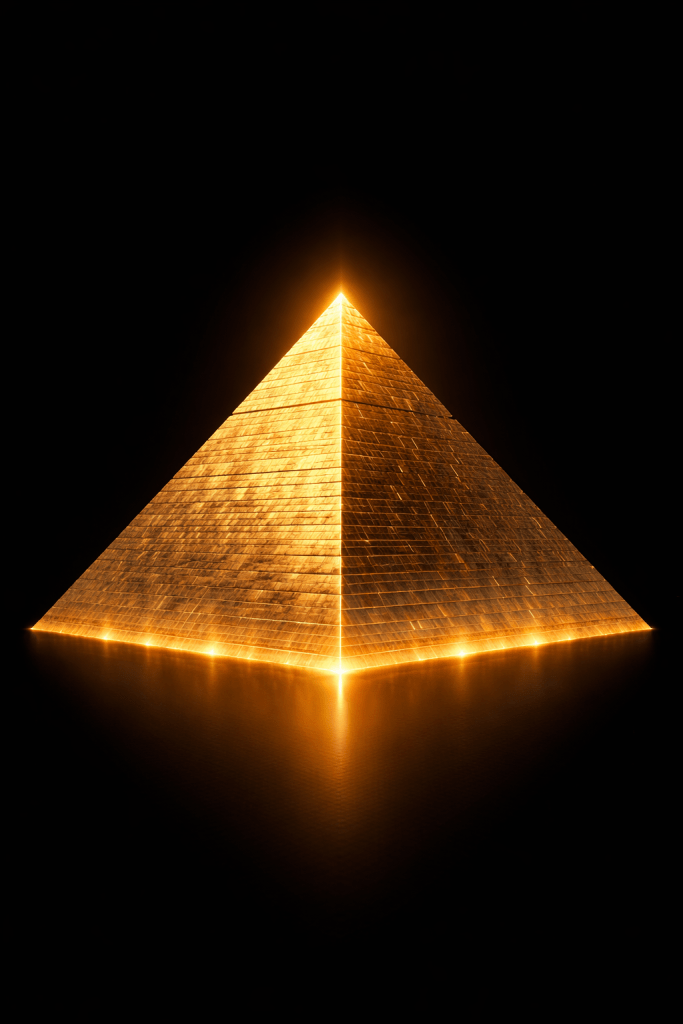
To give the architectonics of the spiritual world an image, one can think of a pyramid consisting of stacked up horizontal planes that are vertically spaced out all the way to the dimensionless point at the apex. The soul starts its journey from the base and must live out the first plane until it has realized all of the possibilities of that plane. Next, it must be reabsorbed and annihilated in that plane in order to reappear as a new form in an adjacent plane right above the previous one. It must then live in that plane for a while until those possibilities are fully realized.
The journey continues upward, the soul undergoing both horizontal evolutions and vertical transformations. But there’s an end to this journey, and that is when the soul reaches the apex of the pyramid. That is when the soul realizes its true nature, its essence, its absolute identity with the Self. It sees, in a sudden flash of insight, that it was not any of the forms it ever identified with, that all the evolutions and transformations belonged to the world of forms and not to the soul itself. It realizes in the permanent actuality of the Self that it was always perfect, that it had never left the home and the center, that the whole pyramid was but a dream of the Apex.
However, the metaphysical structure of the world is present and effective in all scales, just like fractiles. What is true about the soul’s journey has parallels in the sphere of the empirical, human individual and its psychology, for example when it comes to behavior change.
We project ourselves out into the world by anticipating the old, predictable behavior. It’s a efficient means of maintaining what works. But in doing so a lot of non-working behaviors too sneak into the projected bundle and outlive their expiration dates. So, if we live in constant self-projection without reflective breaks, a kind of surrender if you will, we won’t be able to discover new possibilities of being and behaving. We must occasionally stop performing the old role so our agent has a chance to interject and pitch a new role to us. We must stop staring at the projected in order to notice the act of projection and the possibility of creative discovery, as Alli put it beautifully.
Opportunities for such mini-transformations lie precisely in challenging times when an old, default behavior wants to force itself and take care of a situation. It’s then that an attitude of curiosity can loosen the grip of the old and let us ask ourselves, “what if I don’t do this now! What if I try something entirely different and see what happens?” Fuck around and find out. Trust your agent! And if you don’t, then change your agent.
We move through life like polygons convinced we’re complete, each of us clinging to our current shape, mistaking familiarity for finality. The triangle defends its three corners, the square prides itself on its balance, all while missing the quiet possibility of becoming something entirely different. Real change doesn’t come from trying harder within the same form; it comes when we stop insisting on who we are long enough to let something new emerge.
 NOEMAYA